Segement Tree
Source: https://www.dgp.toronto.edu/public_user/JamesStewart/378notes/22intervals/
裡面的 Interval Tree 實際上是對應 Segment tree ,不曉得是不是通用稱法。下面以 Segment Tree 稱之。
名詞介紹
- interval: 由兩個整數 a, b 構成的區間[a, b]
- elementary interval: 加入 integer line 而切割出的不同區段
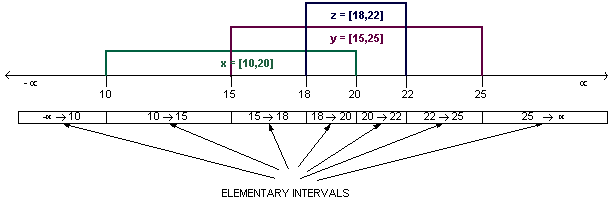
給定 n 個 intervals [ai, bi], for i = 1 … n, 假設這些 intervals 不共享 endpoint,那會得到 2n + 1 個 sub-intervals。
每個 interval 能以 sub-intervals 表示
| **** | Interval | spans Sub-Intervals |
|---|---|---|
| x | [10,20] | [10,15], [15,18], [18-20] |
| y | [15,25] | [15,18], [18,20], [20-22], [22,25] |
| z | [18, 22] | [18,20], [20,22] |
Internal Node & Leaf Node
- internal node: 儲存 key,分離 elementary intervals 至左右子樹
- leaf node: 代表 elementary interval

用途
- 查詢給定點在哪些線段裡
- 括增 BST
- complexity
- Build: O(n log n)
- Query: O(log n+k), n=# of interval, k=# of result
- Space: O(n log n)
- cannot be modified once built
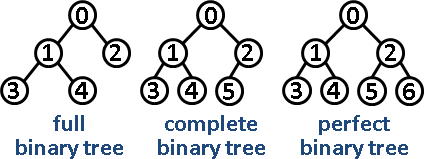
- complete binary tree
各層節點全滿,除了最後一層,最後一層節點全部靠左。
儲存 Intervals
如果於 leaf 儲存 non-elementary interval (涵蓋 elementary interval 的 interval),最糟情況下所有 interval 非常長,所有 leaf 儲存所有 elementary interval,因為有 n 個 leaf,儲存開銷是 O(n^2)。
Segment tree 如何改善儲存開銷?internal node 用 sub-tree 來 span elementary interval 的聯集。
1 | # For example, node 18 spans the interval from 15 to 20 |
把 interval 儲存在 internal node 而不是 leaf 上
An interval [a,b] is stored in a node x if and only if
- span(x) is completely contained within [a,b]
- span(parent(x)) is not completely contained in [a,b]
還能得到兩點
- interval 只會出現最多兩次在同一 level
- 儲存空間 O(n log n),實際上是 2 n log n (稍候證明)
Example
| Interval | Composer | Birth | Death |
|---|---|---|---|
| A | Stravinsky | 1888 | 1971 |
| B | Schoenberg | 1874 | 1951 |
| C | Grieg | 1843 | 1907 |
| D | Schubert | 1779 | 1828 |
| E | Mozart | 1756 | 1791 |
| F | Schuetz | 1585 | 1672 |

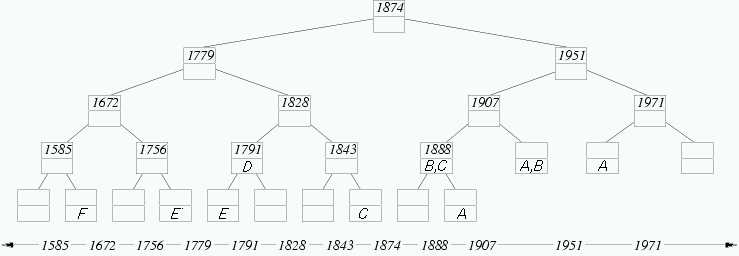
ex1
Grieg’s lifetime = [1843,1907] 儲存在 node 1888,因為
- span(1888) = [1874,1907] is completely contained within [1843,1907] and
- span(parent(1888)) = [1874,1951] is not completely contained within [1843,1907].
ex2
- 尋找包含 G = [1672,1779] 的 nodes
- 將 G 帶入 [1672,1779] 所 span 的 elementary node
- 檢查 (1), (2) 直到 G 無法再往 parent 移動
ex3
proof: Given this information and the fact that a tree of n intervals has O(n) leaf nodes, what is an asymptotic upper bound on the space required to store the n intervals inside the tree nodes? Assume that an interval requires O(1) space for each node in which it is stored.
查詢 Intervals
給定 integer k 和 interval tree T,列出所有 T 內包含 k 的 interval。
1 | An interval [a,b] contains k if a <= k <= b. |
作法如下
- 在所有的 leaf (elementary interval) 尋找包含 k 的 interval
- 在所有的 interval node 尋找包含 k 的 interval
總結就是以 root-to-leaf 的方式找尋
- 包含 k 的 interval 和 leaf (elementary interval)
用下述作法找出的 interval 為 [a, b)
1 | listIntervals( k, x ) |
插入 Interval
在 internal tree 中插入 interval [a,b],假設 a, b 已在樹內。
- 從上到下找尋 node 所 span 的範圍在 [a, b] 內
- (rule 2 已經滿足,否則不會接觸到該 node)
inrerval 有可能儲存在不同子樹的線段內,因此左右子樹都要尋找
以 binary search 的方式往下尋找,符合 rule 1 就插入該 node 或是碰到 leaf 停止。
1 | /* addInterval( I, a, b, min, max, x ) |