Interval Tree
Source: Geeks for geeks-Interval Tree
考慮已有一 interval 集合,要對其進行以下操作
- 新增 interval
- 移除 interval
- 查詢 interval x 是否與現存任意 interval 重疊
Interval tree
- 滿足上述操作在 O(log(n)) 內完成
- augment a self-balancing BST (Red Black Tree, AVL Tree)
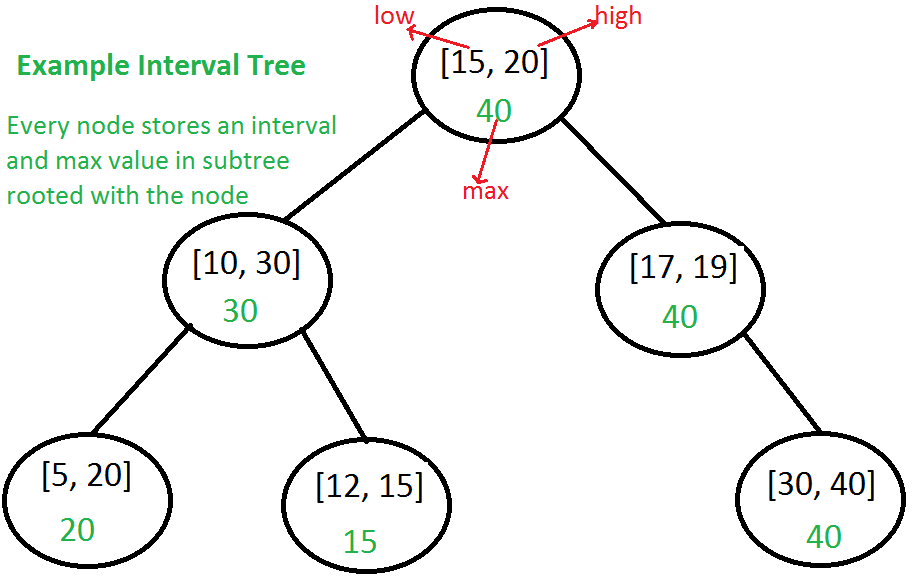
每個節點儲存
- interval: [low, high]
- max: subtree + 節點自身的最大值
用 low 作為的排序依據,insert 和 delete 操作與 self-BST 一樣。
Query
假設 interval x 與 interval tree 內的一個 interval 發生重疊,重疊的 interval 只會在
- 節點自身
- 左子樹
- 右子樹
最終演算法只會返回一個結果,因此多個重疊的情況也可限縮成只與一個 interval 發生重疊。
給定 interval x: [low, high]
現在 x
- 不與節點自身發生重疊
- 左子樹不存在或是 max < x.low
我們可以得出重疊的 interval 可能在右子樹的結論
1 | *When we go to right subtree, one of the following must be true.* |
對應的實作
1 | Interval *overlapSearch(ITNode *root, Interval i) |
若以普通的 binary tree 進行實作,建立 n 個 interval 的最差時間複雜度為 O(n^2),改用 self-balancing tree 可減至 O(n logn)
Other Operations
除了一般操作
- Insertion: Add a new interval to the tree.
- Deletion: Remove an interval from the tree.
- Query: Find the interval in the tree that contains a given point.
和 BST 常見的操作
- Traversal: Visit all intervals in the tree in a specific order, such as in-order, pre-order, or post-order.
- Merge: Combine two or more interval trees into a single tree.
- Split: Divide a tree into two or more smaller trees based on a given interval.
- Balancing: Maintain the balance of the tree to ensure its performance is optimized.
interval tree 還有更多操作
- Range query: Find all intervals that overlap with a given range.
- Search: Find all intervals that overlap with a given interval.
Segment/Interval/Range/Binary Indexed Tree comparsion
- Segment tree
- stores intervals
- optimized for “which of these intervals contains a given point“ queries.
- Interval tree
- stores intervals
- optimized for “which of these intervals overlap with a given interval“ queries.
- It can also be used for point queries - similar to segment tree.
- Range tree
- stores points
- optimized for “which points fall within a given interval“ queries.
- Binary indexed tree
- stores items-count per index
- optimized for “how many items are there between index m and n“ queries.
1 Dimension
k is the number of reported results
| Operation | Segment | Interval | Range | Indexed |
|---|---|---|---|---|
| Preprocessing | n logn | n logn | n logn | n logn |
| Query | k+logn | k+logn | k+logn | logn |
| Space | n logn | n | n | n |
| Insert/Delete | logn | logn | logn | logn |